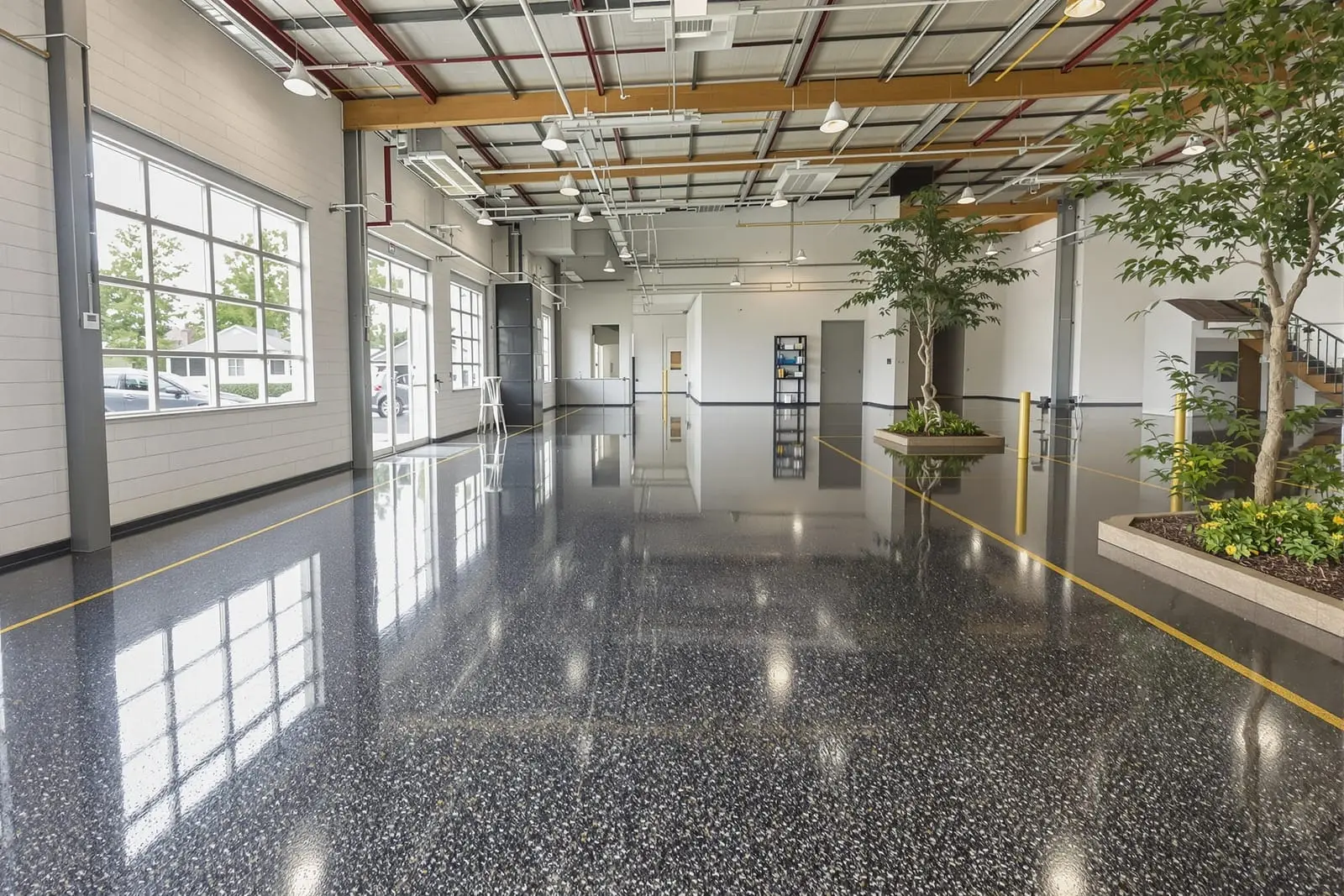
Support heavy operations with industrial concrete floors in Savannah, GA designed for forklifts, racking, and machinery. We pour high strength slabs with proper reinforcement and flatness for efficient operations. Our crew coordinates with your build schedule to keep projects on track. Get durable flooring tailored to your facility demands.
Vanguard Concrete Savannah provides professional industrial concrete floors throughout Savannah, GA and the surrounding area. Our licensed, insured crew delivers safe, clean, on-time work with a free estimate before anything begins. Call (912) 666-6253 or request your free quote.
Industrial Concrete Floors Built For Savannah Warehouses
Industrial concrete floors are the backbone of a safe and efficient warehouse. At Vanguard Concrete Savannah, we focus on floors that can handle forklifts, pallet jacks, high racking systems, and constant traffic without cracking or dusting. Our team works throughout Savannah and Chatham County, including port-adjacent facilities, distribution centers, and manufacturing plants.
When we plan a warehouse or industrial slab, we look first at how you actually use the space. A forklift aisle that sees constant turning needs different reinforcement than a light storage zone. Loading dock aprons need extra attention because of impact from truck wheels and the pounding of dock plates. We walk the site with you, review your equipment specs, and design each area of the floor to match the real-world abuse it will see.
Savannah’s humidity and coastal storms influence everything we do. We adjust mixes, curing plans, and scheduling so the slab gains strength correctly and resists moisture-related problems. The result is a floor that performs consistently in our climate, not just on paper.
Site Prep And Subgrade Work For Long-Lasting Slabs
Many warehouse floor failures in Savannah start under the concrete, not in it. Soft spots from old fill dirt, organics, or poorly compacted soil will eventually show up as cracks or curled sections in the slab. Vanguard Concrete Savannah starts each industrial concrete floor project with a thorough subgrade evaluation.
We check soil conditions, identify any areas of previous construction or backfill, and confirm that existing base materials are suitable for a heavy-duty slab. If needed, we bring in graded aggregate base, laser grade it, then compact in layers with vibratory rollers to reach the right density. In flood-prone areas or near marshes, we may incorporate thicker base or geotextile fabric to stabilize softer soils.
Drainage is another big factor in Savannah. Trapped water under a slab can cause pumping at joints and premature failure. We plan slopes so that surface water drains away from the building, and when appropriate, we coordinate with your civil contractor to ensure under-slab drainage and vapor barriers are correctly placed.
Before any concrete is placed, we double-check elevations and flatness. This groundwork minimizes future movement and creates a stable platform for high racking and sensitive equipment.
Concrete Mix Design And Reinforcement Options
Industrial concrete floors are not one-size-fits-all. We specify mix designs based on your loading, environment, and budget. For heavy forklift traffic or high rack legs, we typically recommend a higher compressive strength concrete, often 4,000 psi or greater, with a low water-cement ratio for durability.
In Savannah’s climate, we pay close attention to moisture and temperature during placement. Admixtures can help control set times on hot, humid days and reduce shrinkage cracking. For large warehouses that must be poured in multiple placements, we may adjust the mix slightly between summer and winter to keep finishing consistent.
Reinforcement options include conventional rebar, welded wire fabric, and various fiber reinforcements. For many warehouse floors we use a combination of rebar at critical areas, such as column lines or thickened slabs at heavy load points, and macro synthetic fibers within the mix to help control shrinkage and impact.
We also discuss jointing strategy early. Sawcut control joints are laid out in a pattern based on slab thickness, panel size, and the building layout. In high traffic forklift aisles where joint spalling is common, we can design larger panels with dowel baskets and carefully detailed joints to reduce bumping and long-term edge damage.
Finishing, Flatness, And Slip Resistance For Busy Facilities
How we finish your industrial concrete floor affects how it performs for decades. For high-bay warehouses in Savannah that use tall racking and narrow aisle forklifts, floor flatness is critical. Vanguard Concrete Savannah uses laser screeds and experienced finishers to achieve the flatness and levelness needed for safe operation of your equipment.
After screeding, we run power trowels to achieve the desired finish. For typical distribution centers, this may be a hard, troweled surface that resists tire wear and dusting. In areas where wet conditions are possible, such as near loading docks, wash-down zones, or process areas, we can adjust the final passes to leave a slightly more textured surface that improves slip resistance without making cleaning difficult.
If you plan to apply epoxy or urethane coatings later, we coordinate the finish to provide the right surface profile and low porosity. In some facilities, especially food handling or packaging, we may recommend a densifier and sealer system that hardens the surface and reduces dust while still allowing future coating options.
Throughout finishing, we monitor weather. On windy or very hot Savannah days, surfaces can dry too fast and cause plastic shrinkage cracking. We mitigate this by adjusting pour times, using evaporation retarders, and ensuring curing starts as soon as finishing allows.
Curing, Joint Treatment, And Long-Term Durability
Proper curing is one of the biggest factors in whether an industrial floor holds up under heavy use. For Savannah warehouses, where humidity is high but sun and wind can be intense, we tailor the curing process to the season. We often use curing compounds or wet curing methods to maintain moisture in the slab during the critical early days, which improves strength and reduces surface crazing.
Joint treatment is equally important. Control and construction joints will move slightly as the slab shrinks and loads are applied. We sawcut joints at the right time to prevent random cracking, then fill them with semi-rigid epoxy or polyurea fillers suited to forklift traffic. This helps protect joint edges from chipping and makes the floor more comfortable to drive on.
In heavy industrial settings, floor abuse does not stop. We talk with you about realistic maintenance, such as periodic joint inspection, cleaning practices that do not deteriorate the concrete, and touch-up sealing where appropriate. By planning these steps early, we help facility managers budget for long-term floor performance instead of reacting to sudden failures.
For facilities near the port or where chlorides may be present, we consider extra surface protection or mix adjustments, since salt and moisture can accelerate deterioration if ignored.
Common Warehouse Floor Problems And How We Prevent Them
We are often called to look at existing warehouse floors in Savannah that were not designed for their current use. Common issues include wide, uneven cracks, joint spalling, surface dusting, and curling along slab edges that makes forklifts bump and racking settle unevenly.
Vanguard Concrete Savannah addresses these risk factors at the design stage. To reduce random cracking, we control the panel size, reinforcement layout, and joint spacing so the concrete has planned relief points. To fight dusting, we focus on proper finishing and curing, and we avoid overworking the surface, which can weaken the top layer.
Curling, especially along sawcut joints and slab edges, can be minimized by balancing slab thickness, reinforcement, and the ratio of top to bottom moisture loss. In Savannah’s climate, we pay extra attention to vapor barriers. A barrier is often required to protect equipment and finishes, but if used incorrectly it can contribute to curling. We select the right under-slab system and coordinate with your builder on how it is installed.
If you already have a problematic floor, we can evaluate whether repairs, overlays, or selective slab replacement make the most sense. Our goal is to keep your operations running, so we schedule repairs in phases and coordinate around your busiest times when possible.
Planning, Scheduling, And Working Around Your Operations
For warehouses and industrial facilities in Savannah, shutting down for concrete work can be costly. Vanguard Concrete Savannah works with owners, facility managers, and general contractors to phase projects in a way that keeps your business running.
In existing warehouses, we can divide the floor into sections, moving materials and racking in stages so you always have functional storage and traffic routes. We plan pour days around your schedule, and for some projects we consider off-hours or weekend work to reduce disruption.
Weather and temperature are always part of our scheduling decisions. Summer afternoons in Savannah can be too hot for optimal finishing, so we may recommend early morning pours. During cooler, damp periods, we adjust our approach to ensure proper set and curing. We also consider proximity to tidal waterways and potential for sudden storms when setting up large placements.
From the first site visit to the final joint fill, we keep communication straightforward. You will know what to expect at each stage, what areas will be inaccessible, and how long each section will need to cure before you can put forklifts and racking back into service.
“
Professional warehouse & industrial concrete floors, done right the first time, quality materials, honest pricing, and results that last.
Vanguard Concrete Savannah
Warehouse & Industrial Concrete Floors Across Our Service Area